Showing posts with label MLP CCG. Show all posts

Sunday, April 17, 2016

Pinkie Pie Grump

This had got to be one of the most devastating cards in this game!

Today I saw Pinkie Pie, Grump excalate up to 231 power.


Let me repeat that:
231 power!

...basically, that's how it left me...

Monday, May 25, 2015

Fire When Ready

From the awesomely new Absolute Discord decks comes Fire When Ready Problem will usually be first greeted with some sort of WTF? comment.

Upon initial inspection it would appear to be a near impossible Problem to successfully confront (let alone solve!). It would appear to be used to switch up both problems (as the simple act of moving/playing a Friend to it will trigger its ability.
"When a character enters play here or is moved here, replace each Problem"

However, there is a way to successfully confront it, gaining 6 points in the process!

First of all you will need Spring Step, Multitalented.

Move or play her to Fire When Ready  first. 

Her ability caused the Problem she's at to "lose and can't have abilities". So long as there are no Friends with a higher power than her, this effect stays.


Next you'll need to get a low powered Earth Pony and a low powered Unicorn to Fire When Ready. Remember, these two new Friends cannot have more power than Spring Step, Multitalented.

Then, play at Home, the Resource Ponyville Banner.

During you score phase, retire Ponyville Banner and you will automatically meet you Problem's requirements so long as you have an Earth Pony, a Pegasus, and a Unicorn at the Problem!

Score 6 points!


Ultimately, I think it would be best to have two (2) Fire When Ready Problems, three (3) Ponyville Banners  (they're cheap 1 AT 0 requirement cards), three (3) Spring Step, Multitalented, and a selected assortment of low powered Earth Ponies and Unicorns.

The real question is, what Mane Character for this deck??


Thursday, April 30, 2015

Absolute Discord - New Ultra Rare Cards!


(Check out their card number designation of these cards! They are # -3, -2, and -1)

AbsoluteDiscord -002


Gummy, Things Just Got Real


AbsoluteDiscord -001


Nightmare Star, Solar Flare


AbsoluteDiscord -003


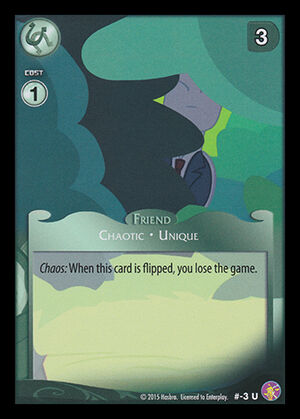
(no name) -blank-
Possibly Slenderpony! 

How in God's name does this card work? Why would you have it (or 3) in a deck?


Ultimately, this card - blank - is a 3 powered Friend that has no requirements and only costs 1 AT. That's a pretty sweet deal! 

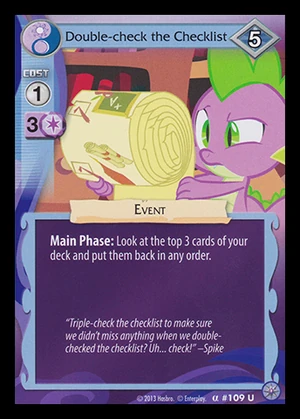
Premiere 109


It would be wise to have other cards that allow you to peak at the top card(s) of your draw deck though. (ie Double Check the Checklist).


Sunday, April 5, 2015

Cards Every Deck Should Have

There are a small handful of cards that every deck in MLP CCG can benefit from.
All of these cards have 0-requirements and thus don't really matter when it comes to the deck's Primary, Secondary, (Tertiary etc) colours. 


This first is from Premiere Series. 
Forest Owl, Novice Assistant is an incredibly cheap card (1 AT) and in combination with other friends becomes a powerhouse!
Every and any deck should carry at least 1 Forest Owl!


Another fantastic card is the Crystal Games' Rainbowfied.
Once played and attached to a Friend, this card gives you the ability to meet and play any colour requirement. Play this Resource onto a Friend with high power and you could potentially meet any requirement!


Premiere Series' Lady Justice, Judge and Jury (again, another Friend with no requirements) is power at first glance. All opponent's Friends at this problem suffer a -1 power during faceoffs. However, Lady Justice's ability also includes your opponent's Troublemaker faceoffs as well!
This is a brutally powerful card. (Possibly even broken!)


And last but certainly not lease, we have Cloudchaser, Flexible Flier, from series 1.
Yet again another 0-requirement Friend. Her ability to allow your next Friend's cost to be reduced by 1 AT can let you play cheap Friends (ie Forest Owl) for free. 
The downside of Cloudchaser is that this card is difficult to acquire, being Rare.


These card can do nothing but compliment any existing deck!


Wednesday, December 31, 2014

The Mystery of Dr. Hooves

Dr. Hooves, as a (blue) Friend in MLP CCG is somewhat of a conundrum. 


There are a total of 4 different versions of Dr. Hooves, all of which are either Rare, Ultra Rare, or promo only.


This poses a serious problem when trying to build a deck using Dr. Hooves'.

Dr. Hooves, Experienced Equine and Dr. Hooves, Unblinking can clearly work together, when Unblinking enters the discard pile it can bring out Experienced Equine out in play at Home, (pay 2 to unfrighten him) and move to a problem.

Although both other Dr. Hooves have abilities of their own (they don't particularly work in any real synergy with the first two), they can - once in the discard pile - power up  Experienced Equine.

(You could choose to discard other Dr. Hooves Friends with Too Splashy).

In order for a deck like this to function, realistically, you'd need 2-3 copies of each card, and that's difficult considering they're all either Rare, Ultra Rare, or promotional.
This is the mystery of Dr. Hooves. I'm not really sure why he's so difficult to find...

Monday, December 29, 2014

Maud Pie is a "10"

Up until now (the release of the Crystal Games expansion) Maud Pie, Rocken' - as a Mane Character - was a juggernaut, reaching a power of 7.

(Base 3 plus 1 per card type in discard pile and there are only 4 card types that can go into the discard pile).


Now, with the release of The Crystal Games 3 copies of Finger Snap can be added into the Maud Pie Deck.

These cheap (1 Action Token, 0-requirement) cards can be saved at play upon a 7-powered Maud Pie, bringing her up to 10-power!


Look out!


Cutie Mark Crusaders, Ponyville Flag Carriers

Cutie Mark Crusaders, Ponyville Flag Carriers.
This new Mane Character doesn't really seem overly powerful... on initial inspection, it seems somewhat weak and slow to flip.


However, I think it's potential is in its deck of Foals.


Although there are many foals characters, it is in Twist, Such a Treat, that we see this potential come to life!
This Friend will nearly always be at +1 (power of 2).


Played in conjunction with (preferably up to 3) Pie Family Rock FarmTwist, Such a Treat, will power up to +4 each turn (on the drawing of 4 cards every turn), making her 5-power. (Have up to 3 in play and it could prove disastrous to your opponent!)

Now, couple these cards synergistic potential with Diamond Tiara (troublemaker) blocking your opponent from scoring on either or both problems and you're free to score every turn.

Diamond Tiara also powers up based on the number of Foals at her problem. Only counting Twist, Such a Treat and Cutie Mark Crusaders, Ponyville Flag Carriers, that in itself is +4. (Making Diamond Tiara at 8-powered Troublemaker!) 

Throw into the mix a deck built upon Foal Friends and this could prove devastating.


Sunday, November 23, 2014

Multi-Support: Advent of a Unique Strategy


The more thought that's put into building a deck around Twilight Sparkle, Friendship is Magic, the more overwhelming it becomes!

Your imagination is the limit. There's very little places you can't go with this new Mane Character.
I think the best plan is to come up with a few synergies (3-4) and slap them together.


What makes deck building difficult around Twilight Sparkle, Friendship is Magic is her potential changes depending on how many player-game you're playing.


The best synergy I've come up with (although it's not limited to Twilight Sparkle, Friendship is Magic) is the Sunny Smiles/Nightmare Moon combo. However, getting your hands on 3 Nightmare Moons can prove difficult if not impossible.

While experimenting with decks around Twilight Sparkle, Friendship is Magicmy son and I realized a unique attribute she has: Multi-support. Having Twilight Sparkle, Friendship is Magic at a problem with Big Mac, Biggest Brother (with Supportive 2) and Twilight Velvet, Proud Mom (Supportive 2) both can trigger.(And in a multi-player game you could have more!).

No other MC has this potential.


If you could make Twilight Sparkle, Friendship is Magic 3 colours (in a 3-player game) - say Purple, Orange, and Blue - she could be teamed up with Big Mac, Biggest Brother (with Supportive 2 - Orange), Twilight Velvet, Proud Mom (Supportive 2 - Purple), and Rainbow Blaze, Dashing Mentor (Supportive 2- Blue), attaining an additional +6 bonus in power (or a total of power of 17 !)


This is my no means the limit. There are 16 Friends with Supportive keyword, and of any and all colours.
Just imagine what potential Twilight Sparkle, Friendship is Magic has in a 4-5 player game...!

Thursday, September 25, 2014

Aggro, Combo, & Control in MLP CCG ??

Aggro, Combo, Control.
These are the basic three archetypes of decks, according to Magic the Gathering (as well as many or most CCG's).

With the new (2013) and increasingly popular My Little Pony CCG, there is a lot of talk about which MLP CCG deck's are which archetype and which Mane Characters lend themselves best to which deck style.

I'm not convinced MLP fits so neatly into these categories.


Let's stick to the simplest for the time being.

Aggro.
Aggressive decks, typically defined as non-interactive, creature focused (either big and powerful creatures or many (cheap) and little), direct damage, with goals to kill your opponent directly and quickly (bring their Life Points to 0).

If we're going to use MTG terms for MLP we'll need to tweak the definitions slightly to fit the theme/game.


  1. non-interactive - this can translate easily
  2. creature focused - this can translate into Friends
  3. direct damage - not so easily translated, there is no direct attacking or damage in MLP, as winning is achieved by attaining 15 points. But this could translate into ability to Confront (solve) Problems easily
  4. kill opponent (reduce Life to 0) - again, there is no objective of 'killing' or wiping out one's opponent, so this too doesn't easily translate.

At initial inspection the first 2 translate pretty well and directly with little modification, but the latter 2 do not. (In MLP, there is no direct damage inflicted and there is no 'kill your opponent' or 'reduce opponent's life to 0').

An Aggro MLP deck would focus on - not creatures - but Friends and since Confronting Problems is how you score points to win, preferably Friends with high Power.

However, it isn't so simple. You can also score points (often alot!) by winning faceoffs - both Problem faceoffs and Troublemaker Faceoffs.

This is done by your Friends' combined Powers and your draw deck - which brings the Draw Curve into this equation of an "Aggressive Deck") (Overall high powered cards, often including Events, Resources, and Troublemakers).

A higher than normal amount of Troublemakers in a deck would definitely swing the Draw Curve towards "aggressive" because of the higher chances of drawing a high powered cards (like rolling a d6 with 4 sides reading "5"), but these same Troublemakers are clearly interactive in play, taking on a less offensive and more defensive roll.

A good example of a MLP CCG "Aggro" deck would be Fluttershy's.
With her Critter Friends - they're cheap, quick to play - and her Caretaker ability, Fluttershy is a brutal and overwhelming deck, clearly in the straight-forward realm of Aggro... but it isn't.

The Caretaker ability is what makes it powerful, and it relies on synergy, or combinations, to function.

The only real "Aggro-trait" this deck has is its swarm-like nature.... of its cheap, low-powered Critter Friends... but, once again, this "swarming" tactic isn't overly effective.

Where this will work in an Aggressive deck in MTG (ie a mono red Goblin Swarm deck), cheap, low cost, fast to play, 1/1 red goblins, will become extremely effective in the early game - however, this same game tactic in MLP (let's stick with the yellow Critter Friends example) won't.

Numerous yellow (butterfly) Critter Friends (0-requirements, 1 AT cost, 1-power) will only get you so far, with a self-rectifying solution.
Here's why;
Firstly, they can only help you confront your opponent's Problem (Your Problem still needs a secondary colour Friend(s)).

The fasted and best case scenario puts a 1-power yellow Friend and a 1-power other-colour Friend at your Problem on Turn 1.
Turn 2 puts 3 yellow 1-power Friend at your opponent's Problem and - to follow the swarming tactic - another 3 in Turn 3.

That's 6 yellow 1-power Friends at your opponent's Problem. Should you enter a Problem faceoff - win or lose - all 6 Friend are returning Home. With no extra Action Tokens to move Fluttershy (in order to flip (boost) her), your Home Limit is still 3. You've just discarded 3 of your "swarming-tactic" Friends.

The game mechanism self-rectifies this Aggro-Swarming tactic.

My point is simply this;
Yes, there are certain MLP decks which function or play more aggressively/offensively compared to others. Yes, some are more defensive compared to others, and yes, some rely on more synergy compared to others... but compared to the MTG main three deck archetypes, MLP CCG does not and cannot fit within its boundaries.

Simply put MLP CCG (any deck) incorporates all these features into itself, and not only requires, but necessitates its players to use offensive and defensive strategies.

I'd be interested in seeing a Rogue deck (non-netdeck) built with no (0) Troublemakers (because they're interactive), no (0) cards with synergies, and either a) all 1-powered, 0-requirement Friends, or b) all very high-powered Friends.

I've seen the results of the first (see Discord & Chaos!). I'd like to see the other.

~ ~ ~

Rainbow Dash, Turbo Troublemaker Deck.


This deck began as the basic, out-of-the-box Rainbow Dash deck. (Primary Colour: blue, Secondary Colour: white. MC: Rainbow Dash, Premier (1st Generation)), and became extremely modified.
It makes a good example because it does not lend itself well into the Aggro-Control-Combo categorization.

This deck carries 14 Troublemakers (nearly 24%), and when the number of troublemakers are this high some interesting effects occur.
Since most Troublemakers have high power (3-6) this drastically increases the Draw Curve. A drastic increase in a deck's Draw Curve moves the deck's archetype towards Aggro.


However, at the same time, the very act of playing a Troublemaker (let alone this high of a percentage) is clearly taking control of the "battlefield". This aspect moves the deck's archetype towards Control.

So, this sample deck, with its high number of Troublemakers,would seem to point towards Aggro-Control.
...but it doesn't end there. With Friends like Scootaloo, Creature Catcher, Big Shot, Wildlife Photographer, and Rising Star, In the Spotlight


and Resources like The High Ground, Foal Free Press, and A Fiery Temper


all working in sync with any and all Troublemakers, as well as Rumble, Fast Learner, Rainbowshine, Cloud Wrangler, Wild Fire, Speed Racer, and Holly Dash, Flighty Filly,


they have their own synergy.


This synergistic aspect moves this deck's archetype towards Combo (Synergy).

Although this specific deck clearly lies dead centre of the Aggro-Control-Combo chart, many if not all MLP CCG decks float and hover within this central region.

Unlike Magic, The Gathering, I believe it is impossible to build a MLP CCG deck that is exclusively any one of these main archetypes (ie a mono red Goblin Swarm deck).
MLP decks may only be referred to as one of these archetype decks in relation to one another, but ultimately are all centrally and evenly balanced.
The game simply doesn't fit these parameters.
The question becomes, what parameters does it fit? What's its measuring stick?


In short, ultimately, my point is that My Little Pony CCG plays drastically different than Magic the Gathering,; specifically that it requires more strategy.

...and because it's 20% cooler.


Saturday, September 20, 2014

Rainbow Dash, Turbo Trouble! Deck


Mane Character: 
Rainbow Dash, Flier Extraordinaire


Friends:
(blue)
Wild Fire, Speed Racer x2
Rumble, Fast Learner, x1
Spike, Baby Dragon, x1
Rainbowshine, Cloud Wrangler, x2
Scootaloo, Creature Catcher, x3

(white)
Big Shot, Wildlife Photographer x3
Rising Star, In the Spotlight x3
Noteworthy, Humdinger x 2
Sugar Twist, Twister Sister, x2


Events:
Fears Must be Faced x1
Gotta Go Fast x1

Resources:
The High Ground x3
Foal Free Press x3
A Fiery Temper x2

Troublemakers:
Changeling Swarm x2
Ahuizotl x2
Jet Set & Upper Crust x2
Lightning Dash x1
Prince Blueblood x2
Purple Parasprite x1
Brown Paraspirte x1
Yellow Parasprite x2
Flam x2

Problems:
795 Wing Power x1
Looking for Trouble x1
Cloudbursting x1
Storming the Villain's Lair x2
I Can Fix It! x1
Clearing Gloomy Skies x2
It's a Twister! x2

Friday, August 22, 2014

The Mana Curves of MLP CCG

(...continued from Faceoffs and The Draw...)

Searching various sites and blogs, we discover some mention of MLP CCG decks' stats.
However, like Trade Cards Online and PonyHead are all little more than distribution charts and card lists.

There are overarching values in MLP CCG decks that should be analyzed.
I think it is important to realize and identify that, unlike MTG, there are two decks present here: The Problem Deck (of 10 cards), and the Draw Deck (of minimum 45 cards).

Some values important to MLP CCG deck could be as follows:

1) Draw Curve for faceoffs (basically a predetermined roll of the d6),
2) Friends Hierarchy, or Requirements,
2) Deck Flexibility, overall deck Requirements,
3) Power vs. Cost ratio,
4) Synergy (which can be brutally difficult if not impossible to measure), and
5) Problem deck overall 'value'.

Let me break them down further.

Draw Curve
This is simply how many of each power cards you have in your MLP deck. This aspect has nothing to do with confronting Problems and everything to do with the random additional card you flip and add during a faceoff (Problem or Troublemaker) – it really isn't random but more of a variance which you can control, in a limited way, and modify.

Basically it is a roll of the d6 except in your MLP deck you have a finite and set quantity of 6's, 5's, and 4's, etc. (Yes, Yes, I know there are some cards that have 0 power (Forest Owl) and 7 (Tree of Harmony), but these are by far the exception. The d6 analogy still works best. Map this out and you get a Draw Curve. This value comes into play and shouldn't be overlooked as faceoffs play an important roll in this game. (Could you really win the game while losing every faceoff?)

A Draw Curve would look like this:
(In this example 2's are the most likely draw, with 6's being rare)
The Draw Curve should be expressed in percentages with the random generator showing as a comparison.


In this (above) example the highest probability on a draw (for faceoffs) is a 1.
This particular example is from a modified Pinkie Pie deck. What's important is that this deck has a fair number of Friends (and the MC) who have the Random ability (which is stackable), thus (potentially) negating this draw result of "1", leading to the second highest draw result of 4 or 5, making this deck good for its random draw results.

Friends Hierarchy:
This is simply taking a tally of how many cards you have with 0 requirements. How many with 1 requirement. How many with 2... etc.
Remember, your Mane Character's colour reduces all those same colour requirements by 1 (ie a purple Friend with a requirement of 1 in Twilight Sparkle's deck must be counted as “0 requirements”).
Tally these totals under the deck's Primary colour, Secondary colour (and possibly Tertiary colour, if applicable).

This gives you a Friends' Hierarchy (or Friends Requirements)


In this example deck there are 9 Friends of the MC's Primary Colour with 0-requirements to play.... but only four 0-requirements for their Secondary colour. (This could prove to be a problem!) Compound this shortage further with 7 secondary colour Friends with 3-requirements and we have problems.

Deck Flexibility:
This could even be referred to as the deck's speed, although 'flexibility' is a more apt title.
Similar to the above Friends' Hierarchy, Deck Flexibility lists all cards from the Draw Deck's requirements (but not categorized by primary, secondary, tertiary colour, but simply by requirements). (These include Friends, Resources, Events, and Troublemakers - TM have 0-requirements). This represents the chances of drawing a card (Action Tokens permitting) that is immediately playable, based on requirements.

In this example, half of the Draw Deck's cards have no (0) requirements. This would be a versatile and 'fast' deck, with many options to play.

Ultimately, what you are going to discover is that a deck's Draw Curve and its Flexibility will become a trade off. You won't find cards that have high power and no requirements. (However, Tree of Harmony, Seeds of Friendship, from the upcoming Celestial Solstice series might very well be an exception, with 7 power and 0-requirements!)

Power:Cost Ratio:
Basically, this is a card's (or the entire deck's) 'bang for your buck'.

This is critical in relationship to any and all card types. Since, unlike MTG, one player will not have a larger Mana Pool to draw from (both players 'score' the same amounts of AT, not counting special abilities – but that factors into synergy and strategy).

These are the equations I use:
Resources & Events:
Power – Cost = value

Friends:
Power  + Special Ability (1 max.) – Cost = value ("French Vanilla" and/or "Double Scoop Vanilla" still only count as a +1 bonus)

Troublemakers:
Power – Bonus – Cost (always 1) – other forced costs (ie Timberwolf) = value

Although this could be calculated for the entire deck, it is better off left on an individual card basis.
(It can be divided by the number of cards in the Draw Deck - don't count problem cards or MC - to give you an per card average.

This factors in derogatory issues like having a deck that is simply too large (After all, according to the rules, there is no max. limit in deckbuilding). My son has a friend with a MTG deck of over 250 cards. It has a good basic balance of mana/creatures/spells (c. 40%:  30% : 30%) (that's over 100 land cards!!) and many good and powerful cards; but it rarely wins. Why? Cards (mostly mana) "get caught in the mode". (...so to speak...)

This doesn't really translate into any sort of chart, and to be honest, these calculations just give you an idea of an individual card's bang for its buck.


For example, if you had to choose between Red Gala
or Golden Harvest (and requirements weren't a factor) Golden Harvest has more 'bang for her buck'.

Red Gala:
Power (+2), Cost (-2) = 0
Golden Harvest:
Power (+2), Cost (-2), Ability (+1) = +1

Golden Harvest has more value.


Synergy:
This is a difficult one to measure and calculate (maybe even impossible). I've yet to figure it out.

~ ~ ~

Then, finally, there's the Problem Deck's value. Have a Problem deck that allows your opponent to confront its problems easier then you and you're giving them points.

A simply equation is as follows:

Your Requirements (-), Opponent's Requirements (+), Bonus (-) = value
A positive value favours you, while a negative value favours your opponent.

Examples:


Timber!

Your requirements are 7 (4 orange + 3 white).
Your opponent's requirements are 9, and its bonus is 2.

-7 + 9 - 2 = 0
It is a balance problem. (You'll find most problems balance out).


Dank Dark Dungeon

Your requirements:  7 (4 yellow + 3 white)
Your opponent's requirements: 9
Bonus: 3

-7 + 9 - 3 = -1
This problem is in your opponent's favour (as it has a negative value).


It's Alive!

Your Requirements: 2
Opponent's Requirements: 4
Bonus: 1

-2 + 4 - 1 = +1
This problem is in your favour (as it has a positive value)


However, these should not be absolute values, written in stone. Problem text as well as their synergy with the rest of the deck definitely come into play. These are little more then estimates.
For Problems, a high bonus score is not necessarily good. You could be giving your opponent these bonus points. Allowing your opponent to be the first to confront a tough problem with a bonus of 3 points (+1) puts them 25% on their way to winning.
Pinkie Pie's deck (unmodified from the Pinkie Pie, Fluttershy, Two Player theme deck) would score a total of -4


Faceoffs and The Draw

(...continued from Discord & Chaos!...)

Underestimating the value of "The Draw" is a critical mistake.
MLP CCG relies on a variable card (not random) in every faceoff. It will usually be between 1 and 6 (as the vast majority of cards' powers are between 1 and 6). However, these variable results are finite and fixed, unlike a d6. (If I roll a d6 29 times, I could - potentially - roll 29 6's. If I flipped 29 MLP cards from my Draw pile, it would be impossible to flip 29 power 6's. This is an important distinction).

Why? Because the amount of 6's, 5's, 4's, 3's 2's, and 1's are predetermined when the deck is built. A random generator has the same chance of rolling any given number. Not so with the draw pile.


On a chart, these chances would look like a straight horizontal line. The Faceoff Draw does not generate random numbers. Only unknown ones.

We'll use the standard Fluttershy's deck (from the Two-Player Set of Pinkie Pie vs. Fluttershy) as an example. Problem cards and the Mane Character don't come into play.

In this deck there are 2 0-powered cards, 16 1-powered cards, 8 2-powered cards, 7 3-powered cards, 6 4-powered cards, 2 5-powered cards, and 2 6-powered cards.

This changes everything with the chances of the Draw. It creates what we'll call a Draw Curve. (In this case Fluttershy has the highest chances of drawing a 2's and 5's. (Now, admittedly, there are other factors that effect and modify this: the abilities of "Random" and "Inspired" are good ones - but we're not speaking of a deck's synergy or a player's strategy; we're only looking at the deck's potential. If your MLP deck contains no 6-powered cards you can never draw a 6).

If we plot Fluttershy's spread of power cards on the same chart we see something like this.
This is the deck's Draw Curve.


(...continued on The Mana Curves of MLP CCG...)